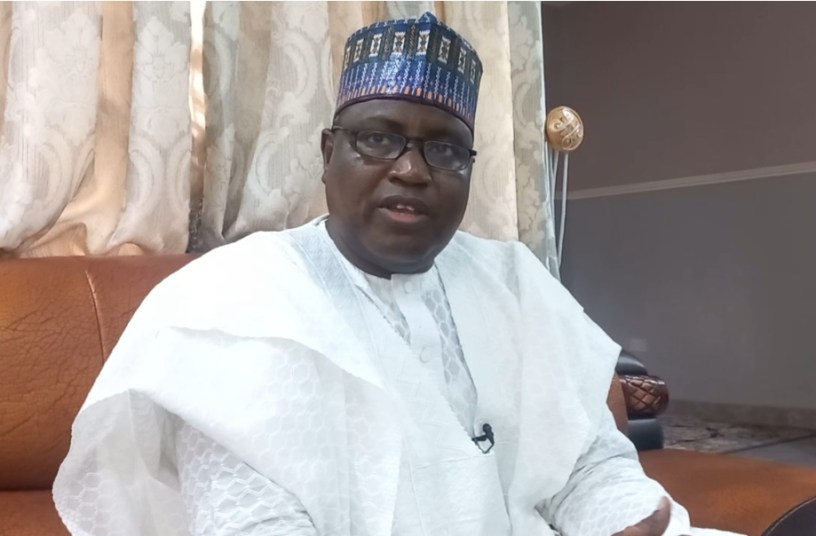
In a recent interview with The Humanitarian Times, Hon Abdulkarim Lawan, Speaker of the Borno House of Assembly, discussed his priorities for his fourth term as Speaker, the plan to have a proposed legislation for environmental protection, cultural preservation through introduction of local language of Borno state, and the ongoing efforts to combat the Boko Haram insurgency in Borno state. Our Editor Abdulkareem Haruna captured the details…
Q: What’s your mood like now as you have been elected for the fourth time as Speaker Borno House of Assembly?
A: First and foremost, I’ll want to thank God Almighty for giving me the grace of being the most elected Speaker of the House of Assembly, having emerged as a speaker for the fourth time. I also express my gratitude to the Governor of Borno state, Professor Babagana Umara Zulum, and our party chairman Hon Ali Bukar Dalori, and my colleagues for the confidence they have in me to be elected as Speaker of the 7th Assembly, the 8th Assembly, the 9th Assembly and of now as the Speaker of the 10th Assembly. I am so honored, and I promise never to fail them.
Q: What will you be doing differently now as the Speaker of the 10th Assembly?
A: By the grace of Allah, we are hitting the ground running with two critical legislative bills which my colleague and I find very vital to the development of our state. As part of our agenda for the 10th Assembly, we have agreed to process a bill to protect our forests and promote afforestation in the state. This has become imperative in the sense that due to the years of Boko Haram insurgency, our people were not only displaced but also lost their means of livelihood so much that they have turned to deforestation by cutting down trees for firewood, and that includes even economic trees. Our bushes have become so vulnerable and threatened by desertification due to the illicit activities of wood sellers. It is alarming because wood telling has become a multimillion-naira business industry, and people are risking their lives in dangerous areas to fall and fetch wood. So we believe this bill will help to regulate these activities and save our environment. The bill will prohibit illicit wood-telling and introduce compulsory tree-planting activities across the state. We feel it is essential to enact this law to improve our environment.
Secondly, we will be working on a culture preservation bill that will introduce the teaching of our local languages in both primary and secondary schools of Borno state. We want to make our major local languages – Kanuri, Shuwa, Babur-Bura, Marghi, Kibaku, etc. be taught in our public and private schools in Borno state. We believe culture is corollary to language – when you speak your language, you will be preserving your culture. So when the bill is passed and enacted, the schools in Borno North and Borno South will introduce Kanuri and Shuwa, while schools in Borno South will make the learning of Babur-bura, Kibaku, and Marghi compulsory for pupils and students.
There will be many other private and executive bills that the Tenth Assembly will pass – and all will be geared towards the development of our people and the state in general.
Q: How would you say the Borno State House of Assembly, under your leadership, has contributed to the fight against Boko Haram insurgency?
A: One of the significant contributions of the Borno Assembly towards the fight against Boko Haram is the passage of the law that brought in the Civilian-JTF under the Borno Youth Empowerment Scheme (BOYES). We are all witnesses to the fact that the coming of C-JTF forced Boko Haram to flee the cities and towns into the bushes, and since then, they have never returned. Another bold step taken to erase the Boko Haram ideology was the signing of the State University Act, which gave birth to the establishment of Borno State University (BOSU). That step was deliberate because we wanted to promote Western education even though that was what the insurgents stood against. We have also passed a law that established Borno State College of Health and College of Nursing as part of our desire to encourage scholarship amongst our youth so that they can be employable. We have passed the Borno State Education Trust Fund Bill.
Q: You’ve said several times that your local government area, Nganzai, was inaccessible because of Boko Haram activities. What is the situation there now?
A: Yes. Sadly until now, there is no single soul in the local government headquarters – no civilian or military presence there until now. Though some villages around the local government have some civilian presence, they are just there on their own – there is no military or police presence there. That’s why I will continue to appeal to the federal government to help us restore normal in Nganza local government so that our people will end this life in displacement and return home for good to continue their livelihood. For now, my local government is partially under the control of Boko Haram.
Q: You’ve, so far, worked with two governors since 2012 to date. How would you appraise the relationship between the executive and legislature?
A: The relationship is perfect and very cordial. From 2012 today. There hasn’t been any dispute between the two arms of government. And this is because we have been members of the same political party, and the governor has given us more than enough support to function. Thank you
 The Humanitarian Times