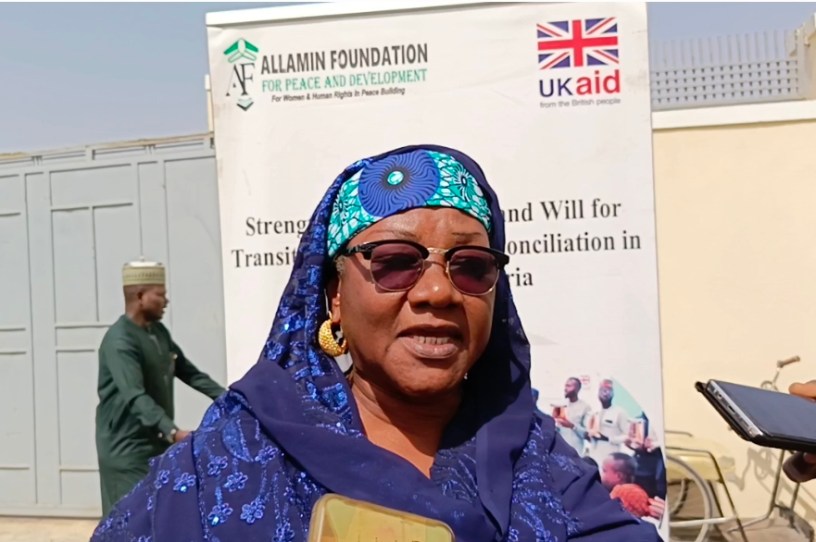
In a region deeply affected by the insurgency of Boko Haram, efforts toward reconciliation, reintegration of repentant fighters, and transitional justice are of paramount importance. Allamin Foundation for Peace and Development, under the leadership of Hajiya Hamsatu Allamin, has been at the forefront of these efforts. Recently, the foundation held a review and reflection event centered on the ‘Strengthening Capacity and Will for transitional Justice and Reconciliation in Borno State’ project. The Humanitarian Times Editor, Abdul Kareem, had the opportunity to sit down with Hajiya Hamsatu to delve into the essence of this event and explore the journey and challenges encountered in the pursuit of transitional justice and reconciliation.
TheHumanitarianTimes: Hajiya Hamsatu Allamin, could you begin by explaining the purpose of the recent review and reflection engagement your organization held on ‘Strengthening Capacity and Will for transitional Justice and Reconciliation in Borno State’ project and your progress so far in this area?
Hamsatu Allamin: Certainly. After months of activity promoting, advocating, and training on the transitional justice system, we have taken stock of our progress at various levels. In fact, many of you here are beneficiaries of what we are doing and are active participants as well. We have acknowledged our activities, celebrated our successes, and identified lessons learned. We have also recognized good practices that we hope can be scaled up. However, our primary goal is to receive stakeholder feedback. If there are any areas where we could improve or actions that should have been handled differently, this is the time we expect our stakeholders to open up and inform us. This feedback will shape our future programming, redesigns, and interventions. So far, members of our Transitional Justice Media Forum and our community advocates on transitional justice and reconciliation are performing well. The community dialogues we have undertaken across all communities, as well as our advocacy to government stakeholders and communities, have been successful due to your support. These achievements are not only for the Allamin Foundation but are the result of a collective effort.
TheHumanitarianTimes: The number of repentant Boko Haram fighters continues to grow. How can this positive trend be sustained?
Hamsatu Allamin: Praise be to God. Over a hundred and sixty thousand have surrendered, including fighters and others. We have addressed their perspectives, concerns, fears, and aspirations. These fears and concerns are genuine. Therefore, what we did at our level, with all of you as witnesses, was identify the genuinely radicalized women and children among them and initiate direct engagement. This approach allowed us to understand the level of radicalization, which was significant. This mindset has deeply infiltrated their thoughts and beliefs. Religion is the only means by which we can debunk these tendencies. We began one-on-one and group sessions to understand them better. Some even accused me and Islamic scholars of being unbelievers. This is the extent to which these people have been radicalized. However, through various sessions, they have begun showing remorse. Some have even revealed their trauma and are seeking forgiveness. We then returned to the communities to engage leaders and individuals, particularly women and young people, many of whom are also victims. As community leaders and women leaders, we had to decide: do we reject them, pushing them back into the wilderness where they may return to commit more atrocities against us; or do we acknowledge that they have been misinformed and uninformed so that we can correct these radical tendencies and make them active citizens? As of now, out of the 90 we have tested, about 80 have become community peace champions. Some women have even convinced their husbands to undergo the same transformation. This is a significant achievement for us and our communities.
TheHumanitarianTimes: Allamin Foundation seems to be a lone voice or the most visible organization working towards a transitional justice system. What challenges have you encountered so far?
Well, I wouldn’t say we are a lone voice, as even international actors are addressing the issue of transitional justice. Its momentum is growing, but the challenge is that people do not understand what it takes. One needs to be grounded, understanding the core and root of the issues before addressing them. Without that understanding, no matter the resources or knowledge, it becomes very difficult. Hence, we may seem solitary. But we have been involved since the beginning of this campaign. We are connecting locally and globally, gaining the knowledge and skills necessary to engage with these individuals. Trust has been built between us and the community, and even the radicalized individuals. This trust comes from engaging with them as far back as 2010 to 2011. That’s why it may seem like we are a lone voice. But we always act proactively, even when not many people are aware of it. You cannot just dive into this issue from the top and expect to achieve anything significant. That’s why we are calling on everyone to come together, understand the issue, and collectively find a solution. Thank you.
TheHumanitarianTimes: Thank you for sharing your insights, Hajiya Hamsatu Allamin. Your dedication and efforts in promoting transitional justice and fostering reconciliation are truly commendable.
Hamsatu Allamin: Thank you too for your good work and the support.
 The Humanitarian Times