By Abdul Kareem
Borno State, Nigeria – The Center for Advocacy, Transparency, and Accountability Initiative (CATAI), in partnership with ActionAid Nigeria and funded by DANIDA, has recently carried out an extensive study to evaluate the government’s performance and interventions in Borno State’s agricultural sector. The study also examined farmers’ strategies to mitigate and adapt to climate change.
The report, titled “Scorecard on Assessment of Government Performance and Interventions on Agricultural Sector and Farmer’s Mitigation and Adaptation Approach to Climate Change Effect in Borno State”, is set to serve as a potent advocacy tool.
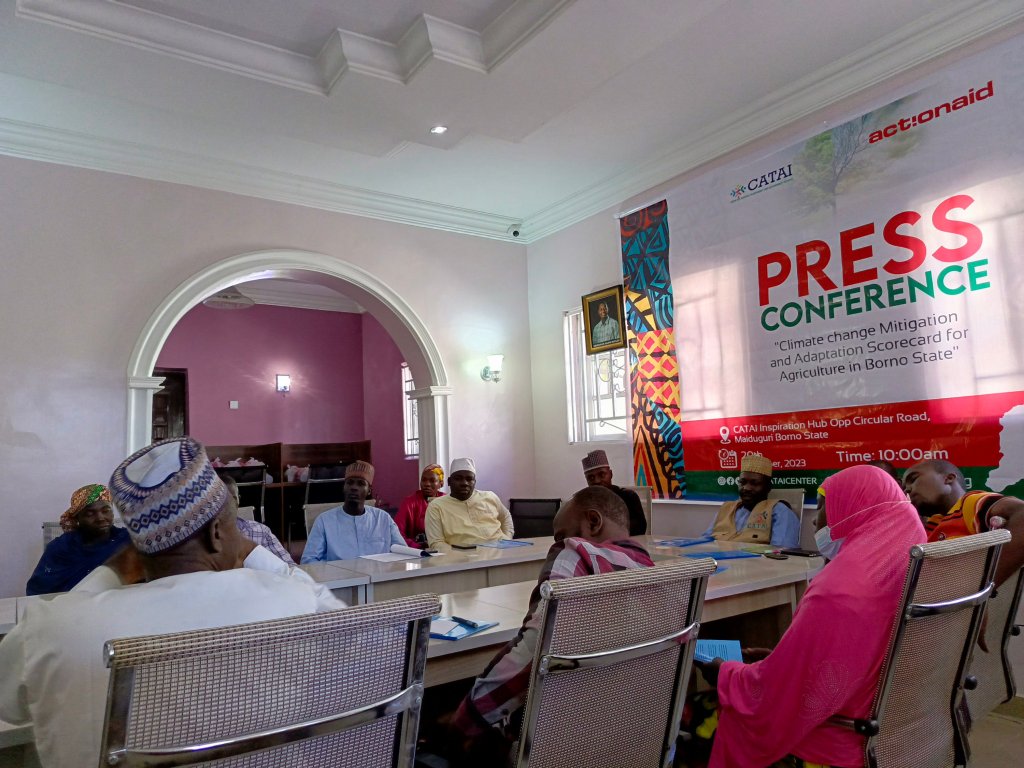
Addressing a press conference on Wednesday, Dec. 20, at their new office in Maiduguri, Borno state, officials of CATAI said the data collected will facilitate communication and demand accountability from policymakers, urging them to advance human rights, democratic principles, and sustainable livelihoods.
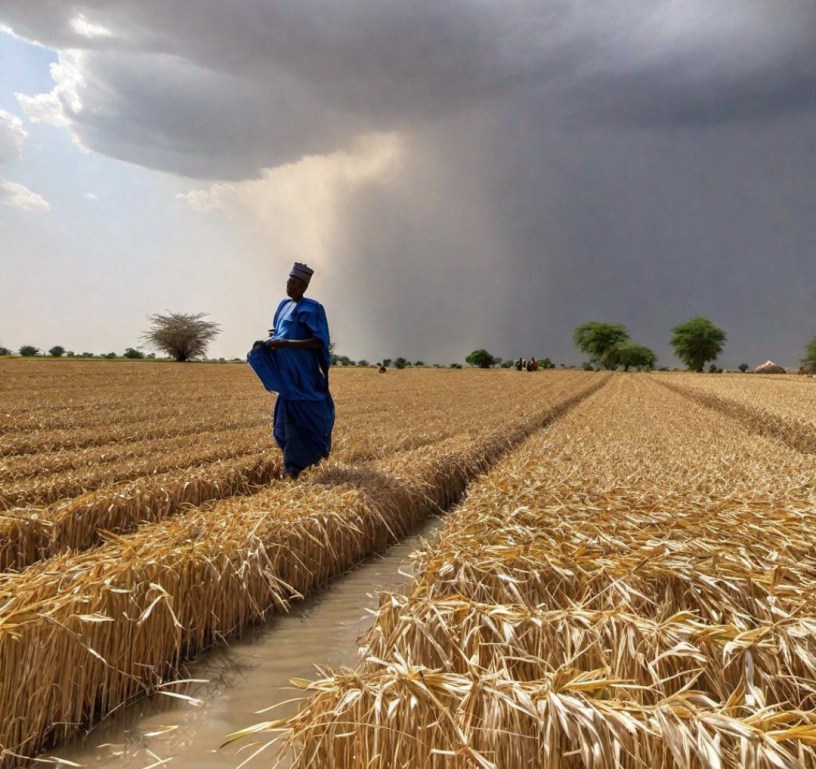
Ishaku Yohana Balami, a programme manager at CATAI who delivered the press conference and led discussion with stakeholders at the meeting, said the study has unearthed striking findings, revealing the far-reaching effects of climate change on Borno State’s farmlands.
“A significant 41% of farmers reported substantial losses due to environmental challenges and climate-related crises such as floods, droughts, pests, and diseases,” he said.
These challenges, according to him, not only diminish farmers’ profits but also pose a serious threat to food security and the overall sustainability of agricultural practices in the state.
Alarmingly, “81% of farmers expressed dissatisfaction about the lack of government support in the face of climate-induced shocks, pointing to a glaring gap in the state’s current approach”.
The findings call for a reevaluation of existing policies and the swift implementation of robust frameworks that prioritize effective support, mitigating losses, and facilitating the recovery of the agricultural sector.
The study, which built its foundation on a meticulous methodology that combines focus group discussions and both open and closed-ended questionnaires, collected primary data from 90 farmers and additional data from the Ministry of Agriculture and Ministry of Environment and Natural Resources. This comprehensive approach provides a robust basis for informed decision-making.
In response to the findings, the report proposes a series of recommendations for government authorities, agricultural development agencies, and research institutions. These recommendations call for the proactive inclusion of climate risk factors in agricultural planning, an increase in budgetary allotments to the agricultural sector, and the creation of a comprehensive climate-resilient emergency response plan.
Furthermore, the recommendations advocate for “the creation of farmer outreach programmes, the establishment of support mechanisms for market access, and the formulation of gender-inclusive policies. Research institutions are also urged to prioritize investigations and testing aimed at creating climate-resilient crops and technology.
Speaking to The Humanitarian Times, Mr Balami said scorecard has rated the Borno state government about 65 percent which represents a pass mark but insisted that the current efforts being made by government to bolster food security in the state should be doubled in the face of the rising challenges of climate change.
Farmers and geographic-consultants at the event took time to lend their voices to the imperatives of saving nine of the stitches with a stick in time.
Most significant of them all was the intervention made by Usman Aliyu, an environment specialist who advocated for the use of carbonized wastes, including rice chaff as fertilizer instead of depending on chemical fertilizers that are harmful to the environment and soil for crop production.
Mr Balami said the report represents a significant step forward in understanding the challenges faced by farmers in Borno State. It calls on decision-makers, governmental bodies, non-governmental organizations, and other stakeholders to focus their efforts on creating inclusive, resilient, and sustainable agricultural policies.
Participant farmers commended CATAI for the initiative stressing that they have learnt news skills and strategy in combating the challenges of climate change.
 The Humanitarian Times