By Abdul Kareem
On the heart of Lake Chad’s receded territory in Nigeria’s northeastern State of Borno, the village of Logumani once stood for nearly a decade as a haunting symbol of the chaos and cruelty of the Boko Haram insurgency. Abandoned and overrun by nature, the village was avoided by many; it was a place where only the brave or the desperate dared to tread. Driving through Logumani was not merely inadvisable—it was tantamount to flirting with death. The desolate roads, flanked by overgrown vegetation, provided ample cover for militant Boko Haram to launch sudden, vicious attacks on unsuspecting travelers as well as security personnel.
The stories of the dangers faced by the Nigerian military in this area were untold and chilling.
In June 2015, a chilling story remains vivid in memory when the then Chief of Army Staff, General Tukur Buratai (now retired), had to travel through Logumani to reach the border town of Gamboru and raise the Nigerian flag after the dislodgment of Boko Haram. His heavily armed security escort faced the daunting task of navigating treacherous terrain, often engaging in fierce gun battles with Boko Haram militants hidden within dense foliage. During the journey, a general was shot and injured, and a private was killed by a bullet fired by Boko Haram. To survive, the soldiers had to maintain continuous gunfire along the lonely highway, littering it with bullets. Until the chief safely arrived Gamboru. The same exercise was repeated on the way back to to Maiduguri. At that time, the fear of the Logumani axis was the starting point for developing survival wisdom.
The village of Logumani became a byword for the lurking dangers posed by the terrorists—a place where every movement could be the prelude to an ambush.
For nearly a decade, the displaced residents of Logumani could only dream of returning to their homes. Their once-peaceful lives had been shattered by violence, leaving them to seek refuge in neighboring communities like Dikwa and Ngala. The memory of their village became synonymous with loss and fear, a ghost town where silence spoke louder than words.
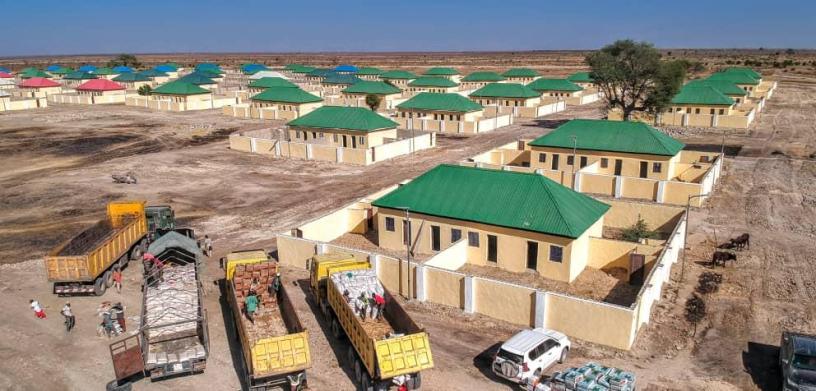
However, the turning point came on a sunny day in January 2024, when Governor Babagana Umara Zulum, amidst much fanfare, declared the rebuilt village of Logumani officially open. The inauguration of 500 resettlement houses was not just a ceremony—it was a declaration of victory over the dark past that had plagued the region. Once a place where even the sun seemed to mourn, Logumani is now a beacon of renewal and resilience.
The reconstruction project, which included the establishment of essential services such as a primary school, health center, police station, and water facilities, was a remarkable feat in the face of the challenges that had long hindered development in the region. The distribution of houses to over 500 families represented a significant step towards restoring the dignity and stability of the community.
Governor Zulum’s address during the ceremony was one of optimism and assurance. He reaffirmed his administration’s unwavering commitment to providing for the people of Borno State, rebuilding not just the physical structures but also the social fabric torn apart by years of conflict. The extensive livelihood support package distributed to returnees further illustrated the holistic approach to resettlement. Men and women received not only financial aid but also the means to re-establish their livelihoods through agriculture and livestock rearing.
Borno officials said that the international community’s involvement, with partners such as Germany, the UK, and the UNDP contributing to the stabilization facility, highlighted the global recognition of the need to support communities affected by extremism. The collective efforts of local leaders and international donors were instrumental in turning the tide for Logumani, transforming it from a place of despair to one of opportunity.
The commendations from local dignitaries, including the Shehu of Dikwa, Ibrahim Ibn Umar El-kanemi, and various political representatives, reflected the widespread appreciation for Governor Zulum’s leadership.
The governor expressed gratitude to President Bola Ahmed Tinubu and the Nigerian military for making the rebirth of Logumani a reality.
Zulum acknowledged the sacrifices made by the military in combating criminal activities even as he said that their sacrifices served as a poignant reminder of the dedication and valor displayed by those who have worked tirelessly to restore peace to the region.
The journey to Logumani by Governor Zulum and his entourage was not just a ceremonial visit; it was a gesture of solidarity and commitment to the people of the village. The presence of elected representatives, government officials, and community leaders underscored the collective responsibility and determination to see the community thrive once more.
The transformation of Logumani from a no-go zone to a rebuilt community is a testament to the resilience and fortitude of the human spirit. The village, which once bore the scars of conflict, now stands as a symbol of hope and renewal. The reopening of Logumani represents a crucial step in the broader efforts to rebuild the lives of those affected by the Boko Haram insurgency, demonstrating that even the most forsaken places can be reclaimed and revitalized.
As the sun set on the day of the reopening ceremony, a new chapter began for Logumani—a chapter filled with the promise of a better tomorrow. The rebuilt village, with its newly constructed homes and restored infrastructure, serves as a testament to the enduring determination of the people of Borno State. Through their resilience and the support of their leaders and partners, they have embarked on a journey of recovery and renewal, and in doing so, they have written a story of hope in the face of adversity.
 The Humanitarian Times