By Abdul Kareem
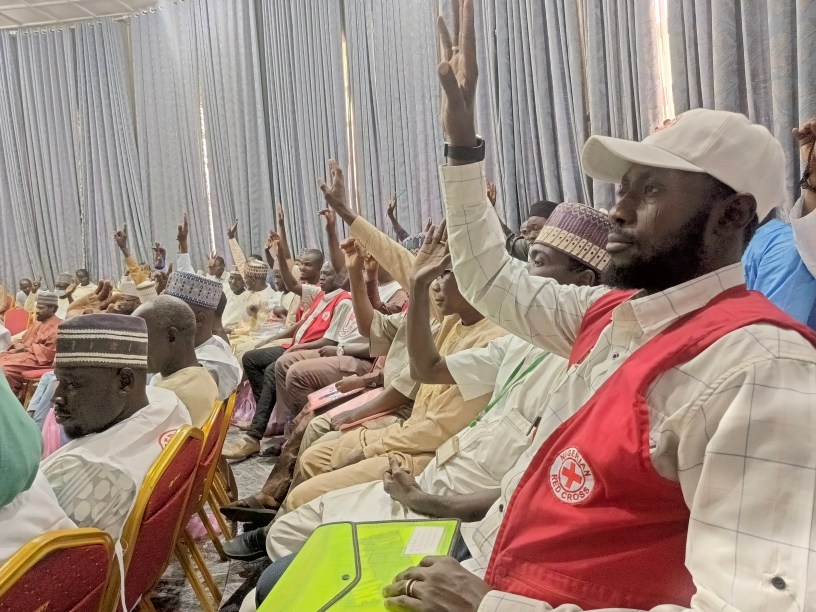
The biggest humanitarian body in Borno state, Red Cross Society of Nigeria, RCN, on Wednesday, February 7, held its 2023 annual general meeting during which it held elections for a new set of governing board members.
At the well-attended meeting held in Maiduguri, the state capital, officials of the humanitarian body from 27 local government areas raised serious concerns about the future of humanitarian service dispensation in the face of dwindling donor funds.
The body observed that as the International Committee of the Red Cross (ICRC) scales back operations across Nigeria, the Borno state branch may be facing challenges to sustain its humanitarian services.
Muhammad Zannah-Barma, the Borno state Branch Secretary of the Nigeria Red Cross Society (NRCS), announced that the ICRC had been forced to shut down offices in over ten states of Nigeria and reduce its staff due to a severe shortage of funds.
“The scarcity of funds has forced ICRC to close offices in more than 10 states in Nigeria as well as cut down staff in remaining states,” stated the Secretary of the Red Cross Society in Borno, he said.
“Before now, ICRC provided support to 19 states but has now reduced to less than 9 states.”
The Red Cross Society in Borno, which receives 95 percent of its operational funding from the ICRC, is now at a crossroads, seeking alternative funding streams to maintain its vital work.
The RCS official said since 2010, the ICRC has been a cornerstone of support for the Borno branch, but as international attention and donor funding pivot towards crises in the Middle East, Ukraine, and Sudan, local operations are at risk.
“We must address this challenge of funding and then improve the capacity of our people to have better access to carry on with our mandate,” emphasized the Secretary.
“Borno has over 10,000 volunteers across the 27 local government areas working under various mental health psychosocial programs, community-based health programs, community sensitizations on outbreaks, healthcare in danger, and delivery of reproductive health kits programs. This is a challenge that we must tackle by putting our heads together to overcome and one of the strategies would be looking inward and seeing how to raise funds.”
During the last year, the RCS Borno branch audit report showed that it spent over two hundred million nairas (₦200,000,000) as incentives for its over 10,000 volunteers providing critical services in all parts of the state – an amount that gulps about 80 percent of the funds it received for that year.
Despite these financial obstacles, the Borno branch remains steadfast in its commitment to providing humanitarian aid to the conflict-affected population. After its annual general meeting, the Secretary emphasized the need to persist in community-based activities, such as first aid services and hospital support, especially for the most vulnerable groups.
“We need to continue providing access to potable water, and healthcare for all the affected population, especially the most vulnerable groups. Thousands of families are separated and need to be reunited. Another challenge is the security situation hindering Red Cross volunteers from reaching certain locations in the state.”
“The NRCS as an auxiliary service provider to the government requires the government to come in and support its activities through annual or monthly conventions,” the Branch Secretary said even as he stressed that “We need to go for aggressive fundraising to boost our funding.”
The event also marked the election of new board members, led by its former Chairman, Alhaji Bulama Mali-Gubio, who was appointed unopposed, reflecting a unified front in the face of adversity. Mali-Gubio is the chairman of the Borno State Civil Service Commission.
The annual general meeting, supervised by the NRCS national legal adviser, culminated in a call to action for members to proactively contribute ideas that would strengthen the branch’s position in Borno’s humanitarian sector.
The reelected NRCS Borno branch chairman, Bulama Mali Gubio thanked the ICRC for taking the lead in funding the activities of the branch even as he commended the Borno State Emergency Management Agency (SEMA) for also supporting them each time they go seeking interventions.
 The Humanitarian Times