By Hamza Suleiman
Before the Boko Haram insurgency, Borno State was one of the most agriculturally advanced states in Nigeria, with over half of its population engaged in cereal crops, livestock, fishery, and poultry production.
This contributed significantly to Nigeria’s food supply, making it a crucial player in feeding the country’s vast population.
However, the insurgency had a devastating impact on agriculture, similar to its effects on the economy and social sectors. The damage was monumental, leading to malnutrition in children and breastfeeding mothers, as well as hunger and starvation among the population, ultimately culminating in a humanitarian crisis in the entire North-East region.
The aftermath of the devastation was estimated to be in the billions of dollars, leaving a significant portion of the population without livelihoods and dependent on food aid from the government and humanitarian organizations.
“In 2009, Professor Babagana Umara Zulum assumed office as the elected governor of Borno State, inheriting one of the worst humanitarian crises in the world at the time, with approximately 2.5 million displaced persons.
These individuals, who previously engaged in rainfed and irrigation activities, cultivating thousands of hectares of arable land across the state’s 20 local government areas, also lost their livelihoods as fishermen and animal breeders.
This significantly reduced the state’s food production capacity to almost zero. As a result, citizens faced hunger and starvation, and the supply of well-bred animals, dried fish, and other fishery products to markets across Nigeria, Niger, Chad, and Cameroon Republics was severely impacted.
Notably, the Federal Government of Nigeria established the Lake Chad Basin Development Commission (LCBDC) in recognition of Borno’s significant contribution to agriculture, fulfilling its obligations to the commission, established the Lake Chad Basin Research Institute in Maiduguri, to enhance studies and innovations in various fields of agriculture for sustainable development in the sector.
“Governor Zulum’s administration inherited a multitude of challenges, including a severe humanitarian crisis, which necessitated a comprehensive approach to address the damage caused by terrorism and restore the state to its former glory.
To achieve this, Governor Zulum, an academic and seasoned public administrator, built upon the Reconstruction, Rehabilitation, and Resettlement program initiated by his predecessor, Vice President Kashim Shettima. This program prioritized agriculture, which received significant attention.
Governor Zulum has reaffirmed his administration’s commitment to transforming the agricultural sector to boost food production, provide livelihoods, reduce poverty, and enhance wealth creation, thereby ensuring food security in the state and the country at large.”
“During the launch of the Renewed Hope Initiative Women Agricultural Support Programme (RHI-WASP), Governor Zulum emphasized the importance of agriculture in Borno State’s development.
He stated, “Our government has made agriculture a top priority, and we are committed to mobilizing resources to boost its growth. To achieve this, we have procured essential agricultural machinery and inputs like tractors, chemicals, and fertilizers.
This will significantly enhance our farmers’ productivity. Our goal is to support our farmers in every way possible to increase their agricultural output and promote food security.”
RHI-WASP is the initiative of the wife of the President, Senator Oluremi Tinubu, designed to encourage women to engage in agricultural activities and contribute to the food sufficiency agenda of President Bola Ahmed Tinubu.
“Governor Zulum’s administration has empowered 120 women farmers from the North-East region with N500,000 each, and 100 persons with disabilities from Borno with N100,000 each, to support their agricultural endeavours.
To promote irrigation, the administration has installed a 90HP capacity solar irrigation pump station in Damasak, distributed fertilizers, and inaugurated the sale of one million litres of petrol at a subsidized rate of N500 per litre to 4,500 farmers, boosting dry-season farming in the state.
The pump station is designed to supply power to three 30HP pumps, discharging 225 litres of water per second through 105 discharge points, covering 125 hectares of rice fields.
This irrigation scheme is part of the administration’s efforts to shift from continuous food handouts to displaced persons and focus on empowering farmers to produce food for their families and have sustainable livelihoods.”
“Governor Zulum emphasized the need for sustainable solutions to address the state’s agricultural challenges, stating that short-term fixes and continuous food aid are no longer viable.
He said, “We must shift our focus from short-term humanitarian support to medium and long-term sustainable solutions, and that is agriculture.”
To achieve this, the government has announced several initiatives to support farmers, including: Procuring one million litres of petrol and distributing it at a subsidized rate to farmers across the state, distributing 20,000 bags of fertilizers, providing 1,000 solar-powered water pumps and 5,000 water pump machines to farmers in the three senatorial districts
These efforts have already benefited 4,500 rice growers, enabling them to cultivate 1,500 hectares of farmland in areas such as Nglayi, Zanna Umarti, Dushi, and Damasak Central.
Another set of 4,500 farmers in Mobar and Abadam Local Government Areas of the state received 4,500 bags of fertilisers; 1,000 water pumps; 9,000 litres of agrochemicals and 50 surface solar water pumps.
To fully utilise the abundant lands and water resources, the state government established modern, innovative and climate-smart irrigation schemes at Bokkoiri in Konduga; Kulunnam in Magumeri, Jaffi in Kwaya Kusar, Mafa in Mafa, Bulabulin, Shuwari and Gajibo in Dikwa and Logomane in Ngala LGA, respectively.
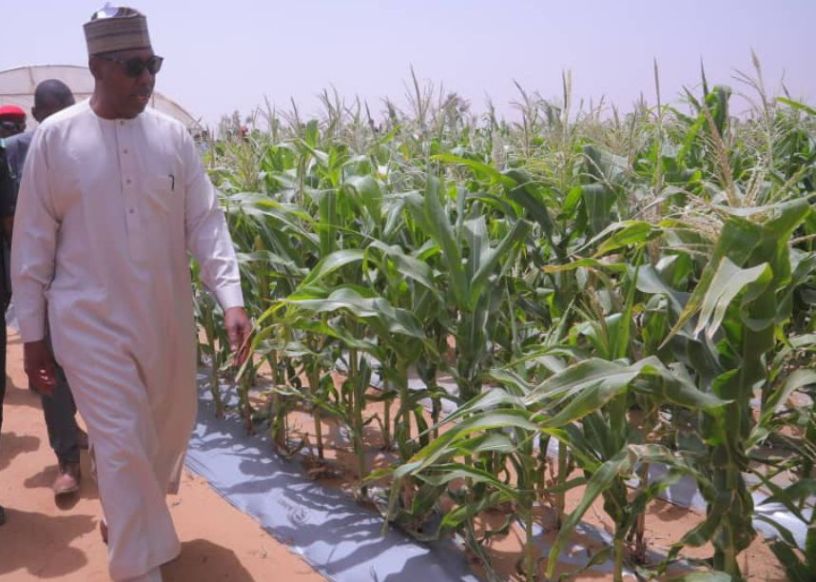
Similarly, the Zulum administration is investing hugely in drip irrigation to accelerate cash crop production such as maize, cassava and sesame seeds, as it has inaugurated a 20-hectare sesame plantation at Koiri pilot drip irrigation scheme.
Under the Koiri scheme, farmers are expected to produce about 364 tonnes of maize and sesame in one crop cycle, and 1,092 tonnes annually. This is in addition to the proposed upgrade of the scheme to 300 hectares the and establishment of a 100-hectare plantation in each of the three senatorial districts of the state.
“Let’s carefully put things in order. Borno State will start exporting sesame and other cash crops shortly.
“We will subsequently change focus and invest our resources in irrigation farming or, rather, food production. I assure you that we will provide the political will needed to achieve food sufficiency.
“We need to expand our scope; we should identify bigger lands, we can expand with another 100 hectares each in Borno Central, South and North Senatorial Districts.
“My predecessor has procured about 10,000 hectares of drip irrigation kits. After this year’s rainy season, we hope the state will be able to cultivate at least 1,000 hectares”.
The Zulum administration recorded significant success in enhancing extension and farmers’ support services as it distributed an improved variety of seeds, fertilisers, chemicals and knapsack sprayers to 3,000 rice farmers at Ngala and Gwoza.
It also provided 250 water pumps, 250 tubewells, assorted seeds, and agrochemicals to 1,000 Dry-season farmers in the Baga resettled community, while 1,000 tubewells and 1,000 water pumps were distributed to rice growers at Damasak in Mobbar LGA.
Farmers in Tarmuwa-Banki also received 50 units of water pumps with accessories, 50 tubewells, seeds, fertiliser, and chemicals for dry season farmers. Also, Zulum has set up 20 hectaress powered irrigation scheme at Bulabulin and Shuwari, fully reticulated with pipe canals as well as provision of additional inputs optimization of three free flow boreholes from 1.5 L/S to 40 L/S for Bulabulin and Shuwari schemes, and another 20-hectare plantation and optimization of two free flow borehole for the Gajbo scheme.
While the the establishment of a 20-hectare similar irrigation scheme and optimisation of two free flow boreholes to 40 L/S each is ongoing at Longome the scheme in Ngala, in addition to the establishment of a 15-hectare solar-powered irrigation scheme at Hausari, Wulgo in Ngala.
Equally, the establishment and expansion of 50 hectares to 100 hectares irrigation schemes are ongoing each at Ladari and Gamboru, to be powered by a 200kw solar powerhouse.
Establishment of solar powered 20-hectare drip irrigation scheme and optimisation of existing tek boreholes at Bokkoiri in Konduga, and 15 hectares solar-powered drip irrigation scheme and optimisation of three existing boreholes at Kulunnam in Magumeri.
Another achievement of the Zulum administration is the construction of earth dams for rainwater harvest at Magumeri, Mafa, Ajiri Chibok, Benesheikh, Auno, Monguno, Rumirgo, Dikwa and Bama, Magumeri, Mafa and Chibok.
The resuscitation of the Nglayi irrigation scheme with a 90kw solar-powered water pump with a full reticulation system has been implemented in Mobbar. This project is critical to sustain dry season activities and mitigate the receding of the Nglayi Lake.
In Mafa; the solarisation of the 35-hectare irrigation scheme had been completed, however, the lands under the scheme are yet to be prepared due to trenches made by the army.
Also, two solar-powered pump stations to water 15 hectares irrigation scheme were completed in Mafa, which would allow the drilling of more boreholes to supply water to farmlands, While the resuscitation of 50 50-hectare Jaffi irrigation scheme has been completed in Kwaya Kusar.
The Borno government under the leadership of Governor Zulum procured and distributed 100 trucks of NPK brand of fertilisers, in addition to the free tractor mechanization services to farmers in 312 wards across the state during the 2023 cropping season
The government also resuscitated Masakwa Sorghum production (Firgi) in Dikwa, Mafa, Ngala, Pulka, and Bama, and andestablishedhana ed 20,000 hectares rice plantation in Mafa, Dikwa, and Jere. While 1,560 extension agents were trained across the 27 LGAs of the state.
Interestingly, 10,000 hectares of farmlands under Mega Farms were opened to encourage IDPs and returnees to engage in farming activities at Gubio, Damboa, Biu, Askira Uba, Shani, Bayo and Konduga.
Farmers also received input and assets including tube wells, water pumps, rice processing mills, threshers, groundnut shellers, and groundnut oil extractors to facilitate value chain activities, at Kukawa, Monguno, Damboa, Bama, Konduga, Jere, Maiduguri, among others.
To encourage agricultural processing for value addition, Zulum resuscitated the Zabarmari Rice Mill in Jere, while another 1,400 hectares for rice irrigation were developed under the TRIMMING project Bayo.
Complete resuscitation of the five-hectare fully automated greenhouse at the industrial hub in the Metropolis in partnership with North Star Agric-Tech to address the inflation of seasonal vegetables dry-off season periods.
On livestock, the government conducted state-wide vaccination of animals against Anthrax in September 2023. Also in February 2024, the Borno government took over the National Primary Animal Healthcare Center, Maiduguri, and the live bird market from the federal government, to enhance the delivery of quality animal healthcare services in the state.
Similarly, the government supplied 1.6 Million doses of Anthrax spore vaccine – ASV & equipment in March 2024, for the next round of animal vaccination in the state.
To boost livestock trade, the Zulum administration embarked on a massive upgrade of major cattle markets across the state including Gamboru, and Banki.
In a renewed drive to encourage poultry production, the Zulum administration undertook the revitalization of PPU’s state-of-the-art hatchery unit and stocking of birds for both egg and meat production in Jere.
Apart from farmer support and extension services, the Zulum administration embarked on a massive road infrastructure project to link and open up farming communities as well as ease the movement of farm produce to the markets.
Road and other social infrastructure development projects executed by the administration are geared towards promoting mutual resettlement and peace restoration, providing livelihoods and boosting commercial activities for the overall social and economic well-being of the people.
In his bid to consolidate the gains in the agricultural sector in tune with the RRR drive and fast-track implementation of the Inclusive Basic Service Delivery and Livelihood Empowerment Integrated Project (IBSDLEIP), Zulum recently sought the support of the African Development Bank (AfDB).
IBSDLEIP is a multi-sectoral programme focusing on the intermediate and long-term components of the Nigerian government’s efforts to respond to the North-East emergency transition, recovery and peace restoration.
The project aims to improve the quality of life by increasing access of the poor and vulnerable segments of the population to basic social services such as water, sanitation, hygiene, health and education as well as restore livelihoods and strengthen food security and safety nets in the states affected by the insurgency.
Zulum, therefore, advocated the application of intelligent energy to convert jumbo boreholes operated by generators across Maiduguri and environs to hybrid, to cut the cost of maintenance and enhance funding to other social services.
Pundits believed that the pace of investment in agriculture and other social infrastructure would in no distant future recover Borno and herald sustainable social and economic development in the state. (NAN) (NANFeatures).
Hamza is a Senior Correspondent of the News Agency of Nigeria (NAN) based in Maiduguri, Borno state.
 The Humanitarian Times