By Abdul Kareem
In a deliberte move towards combating food insecurity in Northeast Nigeria, the Food and Agricultural Organization (FAO) and the Borno State Government have recently launched the 2024 Rainy Season Input Distribution program.
This initiative, held in Maiduguri, the Borno State capital, aims to boost food security and resilience among conflict-affected communities in the region.
Dominique Koffy Kouacou, FAO Representative ad interim in Nigeria and to ECOWAS, highlighted the dire food insecurity statistics revealed in the March 2024 Cadre Harmonisé analysis.
“Out of the projected population, 4.84 million people in Borno, Adamawa, and Yobe states are in a high acute food insecurity situation, an increase from the 4.4 million reported in October 2023,” Kouacou stated.
Kouacou emphasized FAO’s ongoing commitment: “FAO has been implementing an extensive program targeting IDPs, returnees, and host communities in the three states most affected by the conflict. Our emergency strategy aims to strengthen the food production capacity of farming and agro-pastoral communities in these areas.”
The initiative is backed by funding from international partners, including the governments of Norway, the United States, Switzerland, and the European Commission. Kouacou noted,
“This year, FAO is supporting 26,750 vulnerable households with productive agriculture assets to rebuild their lives and livelihoods. In Borno State alone, 9,975 households across seven Local Government Areas will benefit.”
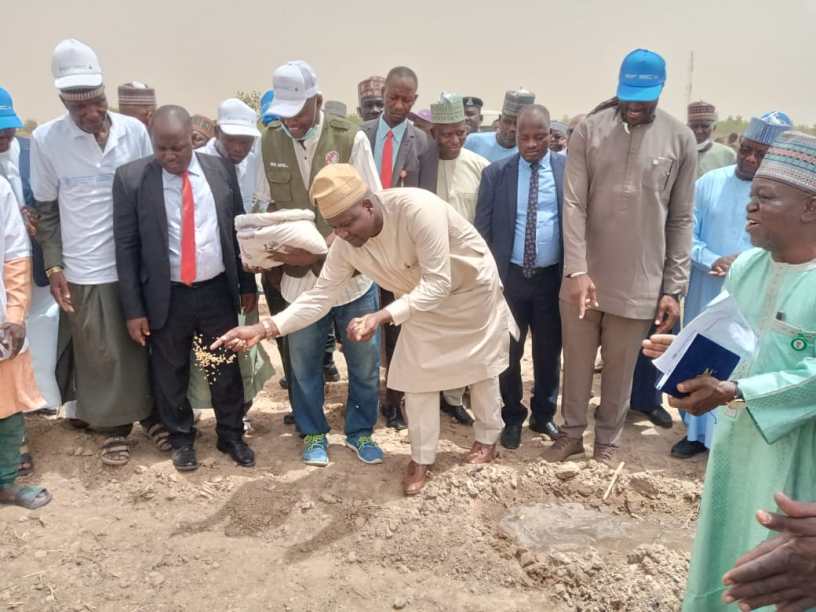
Usman Kadafur, the Acting Governor of Borno State, who led in flagging off the program, expressed his optimism and gratitude during the flag-off ceremony in Dusuman, Jere Local Government Area.
“This bold and imaginative initiative is a collaborative effort to help our people, especially those recently relocated back to their ancestral homes, to restart a meaningful livelihood,” Kadafur said.
“The inputs being distributed today include assorted improved seeds of cereals, legumes, maize, and vegetables, as well as bags of wet-blended NPK fertilizer.”
Kadafur underscored the strategic role of FAO in assisting victims of the insurgency and promoting sustainable peace and security in the state. ”The Borno State Government is aware of the invaluable support and cooperation from FAO. This distribution will encourage our farmers to be more determined in engaging in farming activities, thereby securing a reliable means of livelihood.”
Bulama Gana, Permanent Secretary of the Ministry of Agriculture and Natural Resources, also addressed the audience, reaffirming the government’s commitment to supporting agricultural development. “All vulnerable populations require protection interventions in addition to food, livelihood, and nutrition assistance. The FAO and the Government of Borno have demonstrated a commitment to rebuilding livelihoods in the region,” Gana remarked.
Highlighting the broader vision, Gana added, “FAO’s vision of zero hunger, as guided by the SDG2, drives our intervention through the procurement and distribution of nutrient-dense vegetables, cereals, and legume quality seeds and NPK fertilizers. It is our expectation that these interventions will improve food production, income generation, and resilience among conflict-affected returnee households.”
The Acting Governor, in an interview with The Humanitarian Times said the launch of the 2024 Rainy Season Input Distribution program was a hopeful step towards addressing the multifaceted challenges of food insecurity in Northeast Nigeria.
As Dr. Kadafur aptly concluded, “This administration is ever ready and willing to improve not only the overall agricultural productivity in the state but also to enhance the general standard of our rural farmers who constitute the majority of our teeming population.”
As the rainy season begins, the collaborative efforts between FAO, the Borno State Government, and international partners offer a glimmer of hope for a more secure and prosperous future for the region’s vulnerable populations.
 The Humanitarian Times