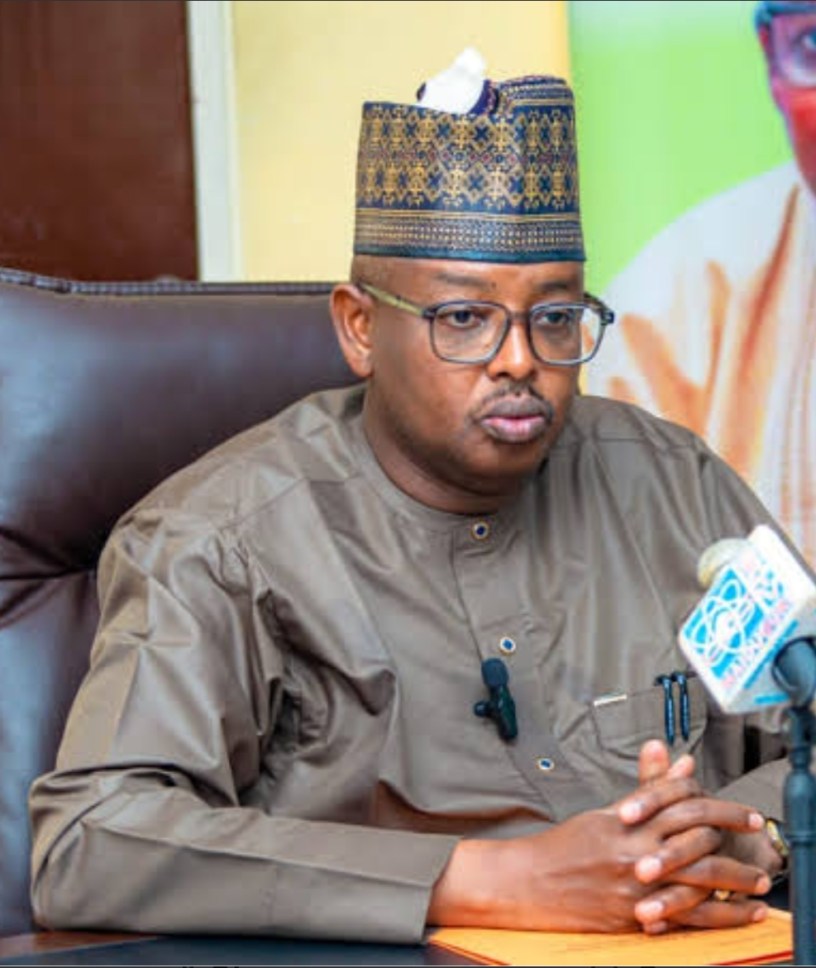
By Abdulkareem Haruna
Whether you admire him or not, Engineer Abba Wakilbe, the Borno State Commissioner for Education, has earned respect for his sincere dedication to improving education in Borno – a state that has suffered significant setbacks in education due to years of violent conflict.
Of course Abba’s unwavering dedication to improving educational access and quality has earned him a reputation as one amongst the most effective commissioners in Governor Zulum’s cabinet. His honesty and straightforwardness in tackling the various challenges in education have helped in building trust among stakeholders and opened doors for meaningful conversations and collaboration. Those who observe him from a distance may misinterpret his unassuming simplicity, but he demonstrates fearlessness and courage when tackling important state responsibilities.
This commitment was clearly evident during a recent advocacy visit by the Allamin Foundation for Peace and Development to his office. The commissioner engaged earnestly with the organization’s representatives, led by its Executive Director, Hajiya Hamsatu Allamin (a seasoned educationist and a pioneer executive secretary of an MDA that would later become Borno state ministry of Women Affairs) and women who have repented from Boko Haram.
Engineer Wakilbe’s candid acknowledgment of the pressing challenges faced by conflict-affected children showcased not only his integrity but also his determination to seek practical solutions.
For the purpose of clarity of record let me say that on Friday, January 10, the Allamin Foundation for Peace and Development, a Maiduguri-based NGO paid an advocacy visit to the office of Borno State Commissioner of Education, Engineer Abba Wakilbe.
The organization’s Executive Director, Hamsatu Allamin, who led the management staff and leaders of women formerly associated with Boko Haram, a non-state armed group, who have since repented to the office of the Commissioner. During the visit, Hajiya Hamsatu Allamin made a passionate plea for the education ministry to assist these repentant women and their children in accessing education as a second chance.
Engineer Wakilbe expressed appreciation for the Allamin Foundation’s efforts and called for an improved partnership with the organization, acknowledging its standout contributions among many others.
However, Wakilbe noted that the state ministry of education faces a significant challenge concerning the future of over 65,000 children born amidst the conflict. He also raised serious concerns about young women rescued from Boko Haram captivity who become mothers before their teens, with some turning to prostitution – a practice foreign to their traditions.
He noted that despite concerted government efforts to deradicalize the women and children, progress has been limited.
“Recently, we graduated some women in our two second-chance schools located in Ngarannam and Bama,” he said. “So far, 300 women have been trained and provided with starter packs to help them rebuild their lives. Essentially, the entire program is designed to address vulnerability. But my particular interest is in Bama; that is why when selecting participants for the training, I insisted that we include regular divorcees, widows, women affected by conflict, and some from among prostitutes, so we can reintegrate them. To God be the glory, we graduated 162 of them, and I checked on them not long ago.”
The commissioner is however concerned that the educational programs offered by donor partners are not adequately aligned with the actual needs of the people and the community – thereby impeding the expected impacts.
“Many agencies have invited us to work on plans as the year comes to a close; USAID was the first, followed by UNICEF. I have consistently focused on one major problem: the conflict-affected children in Hajj Camp. What do we do with them? We face three to four fundamental problems. First, our education system is not equipped to deal with conflict-affected children; those who plan the system have not foreseen this. Secondly, we cannot integrate them with regular children. We tried it, and it failed. They gave me a couple of Chibok girls. When we took them to a women’s secondary school, it failed! The principal said, ‘We can’t handle them.’ We brought them to a Second Chance Training School because we couldn’t manage them. So what do we have in stock for these children? I have engaged the Commissioner of Women Affairs, who has the primary mandate of caring for them. I said, look, the Borno model has helped 410,000 people since it started. We were part of the first committee that initiated this work. Initially, most of the radicalized individuals who first surrendered did so in Cameroon, and we were tasked with bringing them back. I have liaised with them several times, and we have seen them. Our major task is, how do we deal with their children?”
The commissioner acknowledged that the problem in our system is that many stakeholders only want to implement programs as it suits them.
This usually causes him to ask: “What do we gain from it?”
“But nobody considers the long-term objective,” he said. “I have attended several UNICEF programs; I am not impressed with some of them, telling them they were ineffective because they do not address immediate needs. They are trying to teach teachers what is called ‘tal trading’ at all levels. They claim to teach it in the local language, and I saw them teaching in Hausa. So I asked UNICEF, ‘What is the local language in Mafa? Is it Hausa?’ They replied that it is not; it is Kanuri. So, is Hausa a foreign language in Mafa? Yes. If you are wasting time and money teaching them Hausa, why not go straight for English, as we did during our time?
The Commissioner believes that the entire education system in the post-conflict era has been severely messed up.
“I told our donors to focus on conflict-affected children, but we need training on how to handle them. The Allamin Foundation and others have been working for a long time. No one in our history has envisaged a situation where we must cope with these children. So we lack capacity. Secondly, how do we deradicalize them?”
“In educational principles, what do they say? Every child is born ‘tabula rasa. We have to imagine what these kids who are related to Boko Haram have seen. They witnessed their seniors slaughtering and killing people. To them, this was right. So how do we tackle that and eventually reintegrate them into society as normal people?
The Commissioner said the entire problem stems from the collapse of education in our society – a striking departure from what was obtained in the past.
“Let’s not look too far back. We all attended public schools, which provided equality. You only distinguished yourself if you were exceptionally good. Nobody cared who your father or mother was; schools offered equality, which is now absent. This absence contributes to some of these issues. Therefore, I urge partners to support organizations like the Allamin Foundation, so we can address the education of these conflict-affected children. There are 67,000 of them in these camps, primarily women and children.
What happens next? We continue to turn a blind eye until something else occurs. We must think about how to educate them and eventually reintegrate them.
There is something seriously disturbing. As I speak to you, I am the chairman of the reconstruction of Bama and some communities bordering parts of Gwoza because I chair the repatriation committee. While engaging with the society in the border town of Banki, the village head told me something of great concern. He said, ‘We now have many prostitutes in Banki.’ I asked, ‘Prostitution?’ He confirmed it. Prostitution has never been part of our culture.
We discovered that the majority of those engaged in it are underage mothers. I have seen a case of an 11-year-old surrendering with three children. Just yesterday, as I was coming in from Darul Jamal, they came out, raised their hands, and I had to stop. An 11-year-old girl with three children ruined my day. We brought them to Bama, and they will be processed and moved to Hajj Camp.
Not quite a month ago, Cameroonian authorities brought in a truckload of girls. They are captives. I’m caring for 14- and 15-year-olds with up to three, four, or five children. None of them is older than 18. What do we do? We process and profile them, then leave them.
When they return, what do they do? Prostitution.
I told the Commissioner of Women Affairs that I would seek funding and partner support to establish a training center in these border communities, where many of these girls come from, so we can teach them skills like we do in our second-chance program. If we can provide anyone with startup packs, we can offer them a sense of belonging.
Vices like prostitution are primarily attributed to poverty. We have rehabilitated quite a number in our second-chance program, and I have followed up to see that they are doing well. Once you provide an option, they tend to drop out.
We must consider their vulnerability and not only focus on the fact that their rights have been violated. We should not stop at deradicalizing them; we must also look at how society treats them once they complete our program and are reintegrated.
I believe we should seek funding for organizations to address this issue, particularly concerning Bama, Gwoza, and Gamboru Ngala. These three communities should serve as a serious case study because we have numerous cases here.
 The Humanitarian Times