By Abdulkareem Haruna
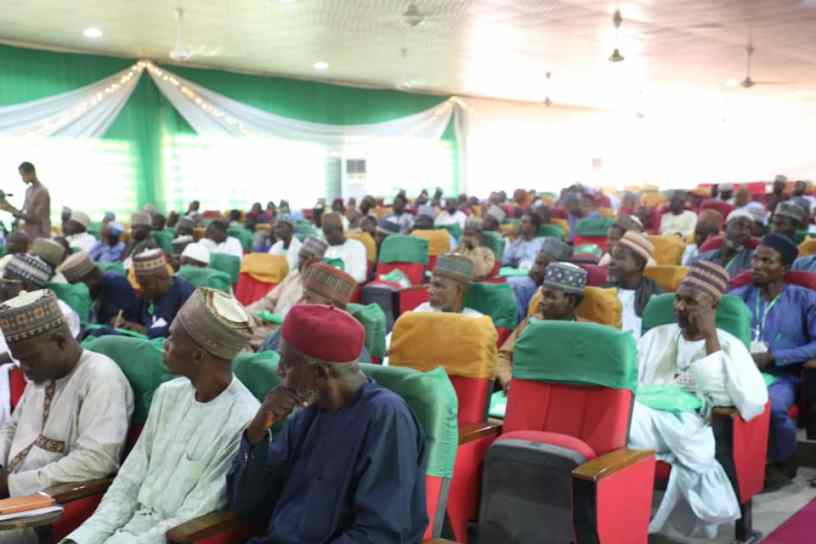
In an effort to advance education in Nigeria’s conflict-ridden northeast, the federal government, in collaboration with regional stakeholders, launched a two-week. “train-the-trainer” workshop for 600 Arabic and Tsangaya (traditional Islamic school) teachers.
The initiative, largely funded by the North East Development Commission (NEDC) held at the Maiduguri campus of the Nigeria Arabic Language Village Ngala, Borno State, signals a renewed focus on improving Islamic educational standards and addressing the region’s high number of out-of-school children.
The workshop, jointly organized by the Nigeria Arabic Language Village (NALV) and the NEDC, aims to equip teachers with enhanced Arabic language skills and pedagogical techniques, alongside skill acquisition training. Officials emphasized the program’s dual benefits, highlighting its potential to not only improve Arabic instruction but also provide teachers with practical skills that can be passed on to their students.
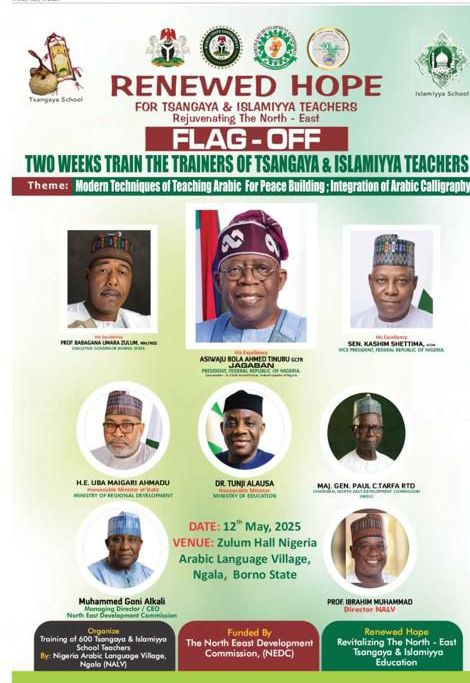
“This initiative marks a bold and pragmatic step toward addressing one of the most pressing educational challenges confronting the region, the issue of Out-of-School Children,” said the Minister of Education, in a speech read at the event by the Vice Chancellor of Al-Ansar University, Professor Abubakar Kundiri, who represented him. He lauded President Bola Ahmed Tinubu’s “vision for inclusive, accessible, and quality education,” and acknowledged the “tireless efforts” of Borno State Governor, Professor Babagana Umara Zulum, in revolutionizing education in the region.
The Minister specifically commended the Managing Director of the North East Development Commission, saying “I say thank you for your visionary leadership and for the Commission’s continuous efforts in providing opportunities and livelihoods across the region. Your support for this pilot phase is not only commendable but worthy of replication by Managing Directors of other regional development commissions across the country.”
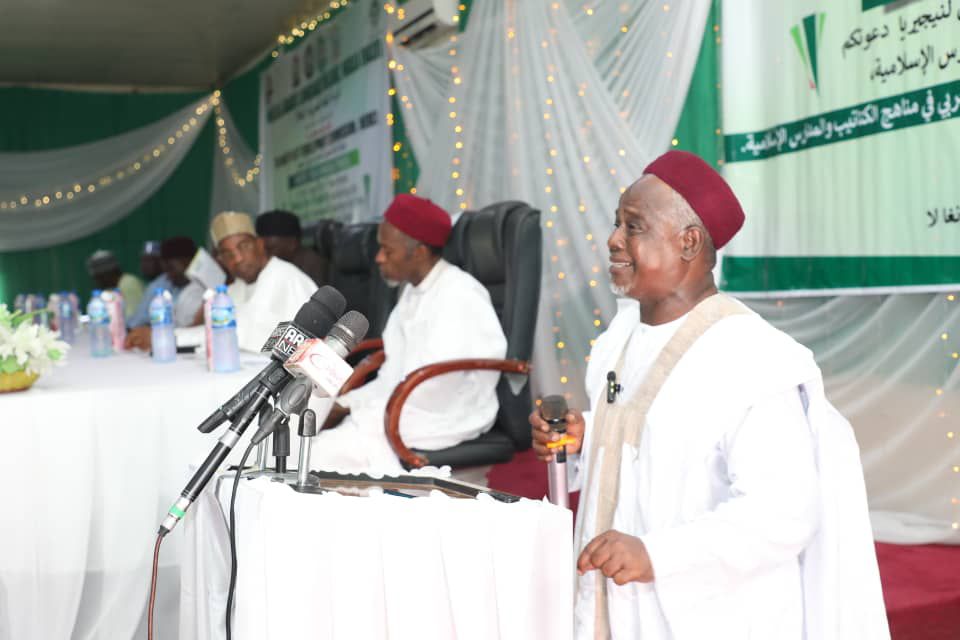
Professor Ibrahim Mohammed, Director of NALV, expressed gratitude to President Tinubu and highlighted the NEDC’s support in making the training possible. He also praised Governor Zulum for establishing the Borno Tsangaya Board, whose curriculum is reportedly being studied by other parts of the country. “Borno is taking the lead in the area of Tsangaya education,” Mohammed stated, adding that the program aims to train 6,000 Tsangaya teachers across the six northeastern states.
The training program also recieved support from traditional leaders. The Shehu of Borno, represented by Mai Terab, Kyari Sandabe, and the Shehu of Dikwa, represented by Abba Musa Abba-Adam, both emphasized the importance of education and urged participants to fully engage with the training.
Deputy Governor of Borno State, Umar Usman Kadafur, echoed the importance of the training. “By investing in those who educate others, we are multiplying impact, fostering sustainability, and ensuring that knowledge flows continuously into our schools and institutions.” He highlighted the role of Arabic language education as a “cultural and religious asset” and a “bridge to broader academic and diplomatic opportunities.”
Dr. Musa Ridwan of the National Board for Arabic and Islamic Studies (NBAIS) emphasized the timeliness of the workshop, particularly its focus on curriculum skills, and acknowledged the tripartite collaboration between NALV, NEDC, and NBAIS.
The initiative comes at a critical time for the northeast, a region grappling with the aftermath of years of insurgency, which has severely disrupted education and displaced millions. Officials expressed hope that this training will contribute to rebuilding the region’s educational infrastructure, empowering its youth, and remedy the culture of scriptural misinterpretations that often lead to extremism and radicalisation.
 The Humanitarian Times