By Abdulkareem Haruna
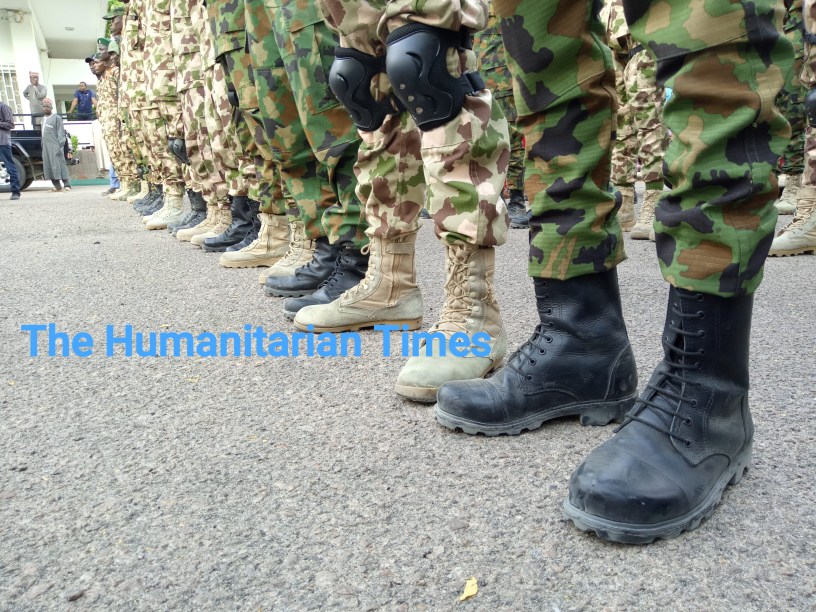
Nigeria Army chief (5th from left) with other senior officers at the biannual COAS conference in Maiduguri. Photo Abdulkareem/HumAngle
Nigeria’s Chief of Army Staff, Lieutenant General Olufemi Oluyede, today, Thursday May 22, acknowledged that the Nigerian Army has “recorded a number of incidents where our brave warriors have paid the supreme sacrifice” in the ongoing fight against Boko Haram and other militant groups.
The General’s remarks came during the opening ceremony of the First Bi-Annual Chief of Army Staff Conference 2025, being held in Maiduguri, the capital of Borno State, northeast Nigeria and an epicenter of the insurgency.
General Oluyede described the loss of troops as “deeply regrettable” and a “painful reminder of the depth of sacrifice” made by Nigerian soldiers.
The army chief’s statement is a rare public admission of setbacks in the protracted conflict, which has plagued Nigeria’s northeastern region for over a decade.
Addressing a gathering of principal staff officers, formation commanders, and heads of army institutions, General Oluyede emphasized the need for “strategic foresight, operational alignment and an insight to where military and community engagements converge.” He reiterated a commitment from the 2024 annual conference to align kinetic (military operations) and non-kinetic (non-military) operations with the “dynamic nature of the operating environment,” noting that “terrorists have adopted new strategies that are aimed at shaping the battlespace in their favour.”
Despite the acknowledged losses, the Army Chief expressed optimism that his troops would triumph at the end of the day .
“However, we must not allow these setbacks to dampen our spirit or diminish our collective resolve to stamp out that which seeks to ridicule the sanctity of our sovereignty,” he stated.

General Oluyede also highlighted the importance of inter-agency cooperation with the Nigerian Navy, Air Force, and other security agencies, as well as collaboration with federal and state governments. He thanked President Bola Ahmed Tinubu for his “strategic guidance and support” and appreciated state governors, traditional rulers, the press, and citizens for their contributions to the fight.
A protracted war
The security situation in Northeast Nigeria remains volatile especially in May 2025, despite years of military efforts against Boko Haram and ISWAP. More than a hundred lives have been lost either through direct attacks on military and civilian locations or through landmines.
While the Nigerian government often claims progress, these extremist groups continue to pose a serious threat, having shifted tactics from territorial control to more elusive asymmetric warfare involving ambushes and targeted killings. This ongoing insurgency complicates efforts to declare definitive victory and maintain sustained peace in the region.
The governor of Borno state, Professor Babagana Zulum has been in the hinterlands for six weeks struggling to motivate troops and encourage besieged residents not to flee. At some points during his tour of the northern and central Borno villages, Governor Zulum beseeched the federal government not to allow the historic town of Marte fall again for the terrorists.
The protracted conflict has fueled a severe humanitarian crisis, with millions displaced and living in precarious conditions within IDP camps in Maiduguri and other urban centers, reliant on external aid. Civilian populations in remote areas remain highly vulnerable to attacks and abductions, and the military itself has incurred significant casualties. These persistent losses, often reported by the local media, contribute to public fatigue and ongoing skepticism regarding the effectiveness of current counter-insurgency strategies.
Economically, the region has been severely impacted, with disrupted agriculture and trade routes exacerbating poverty and potentially aiding extremist recruitment. While the Nigerian government, supported by international partners like the UK, continues to invest heavily in both military operations and humanitarian aid, the sheer scale of the challenge continues to outstrip available resources. The Nigerian military employs a mix of offensive operations and non-kinetic approaches, but the effectiveness of the latter is often undermined by the persistent violence and the military’s struggle to secure all areas outside major urban centers like Maiduguri.
 The Humanitarian Times