By Abdulkareem Haruna
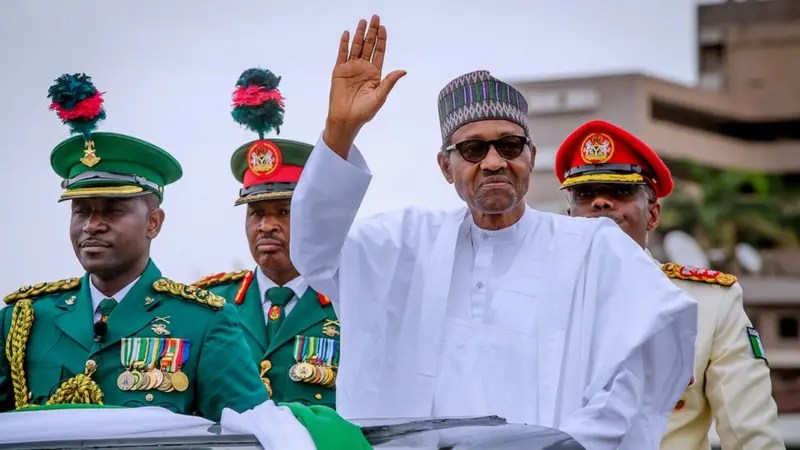
LONDON – Muhammadu Buhari, a former military general who twice ruled Nigeria — first as a stern military strongman and later, after decades of persistence, as a democratically elected president promising to tackle graft and insecurity — died Sunday in a London clinic. He was 82.
His death was confirmed by his former special adviser, Garba Shehu, and widely reported by Nigerian media, bringing to an end a long public life that deeply shaped Africa’s most populous nation. The cause of death was not immediately disclosed, though he had for years been the subject of speculation about his health, undergoing extended medical treatment abroad even during his presidency.

A towering figure both literally and figuratively in Nigerian politics, Mr. Buhari’s career spanned Nigeria’s tumultuous post-independence history. Born in Daura, Katsina State, in 1942, he rose through the ranks of the Nigerian Army, participating in various military coups, including the one that brought Gen. Murtala Mohammed came to power in 1975.
His first stint at the helm came on December 31, 1983, when he led a military coup that overthrew the civilian government of President Shehu Shagari. As Head of State, General Buhari became known for his “War Against Indiscipline,” a strict campaign aimed at curbing corruption and public disorder. His regime was characterized by authoritarian measures, including detention without trial, a crackdown on the press, and the execution of drug traffickers. He was himself overthrown in August 1985 by Gen. Ibrahim Babangida.
After his release from detention, Mr. Buhari largely remained out of the public eye for years, only to re-emerge in democratic politics in the early 2000s. He ran for president unsuccessfully in 2003, 2007, and 2011, before finally achieving his long-held ambition in 2015.
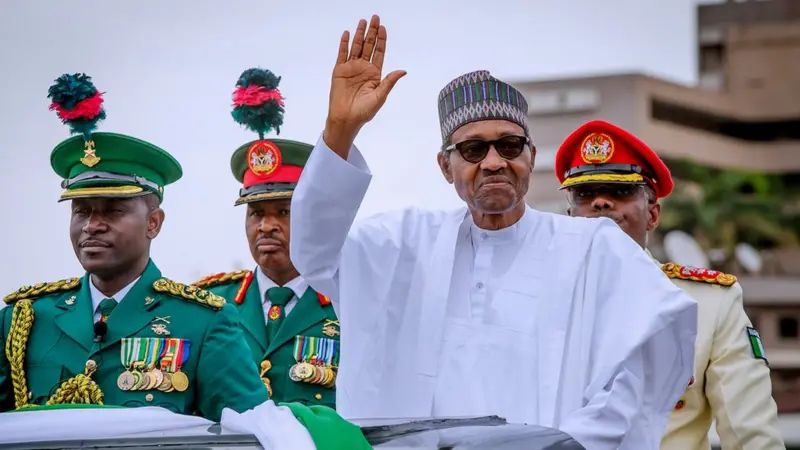
His victory in 2015 was historic, marking the first time in Nigeria’s history that an incumbent president, Goodluck Jonathan, was defeated in an election and peacefully handed over power to an opposition candidate. Running on a platform of change, he galvanized public support with his reputation for incorruptibility – a rare quality in a nation plagued by systemic corruption – and a promise to crush the Boko Haram insurgency that had destabilized the northeast.
During his two terms (2015-2023), President Buhari’s administration made some strides, particularly in infrastructure development. His government oversaw the completion of significant projects, including the Second Niger Bridge, various railway lines, and road networks, aiming to connect regions and boost economic activity. Efforts were also made to diversify Nigeria’s oil-dependent economy, with a focus on agriculture and solid minerals.
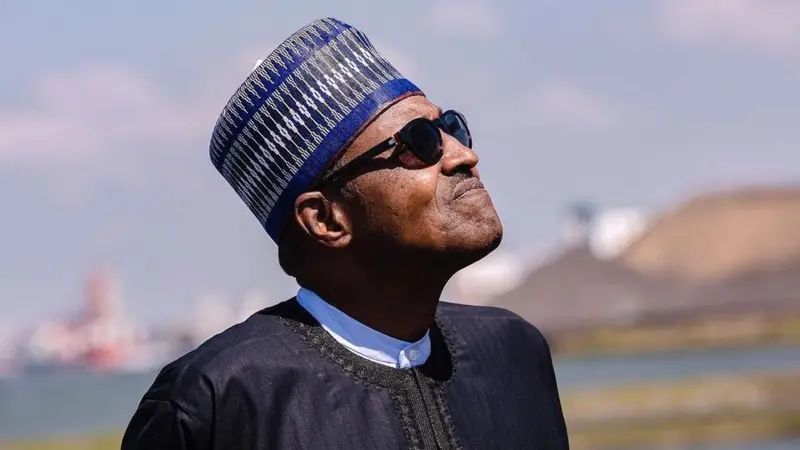
However, his presidency was also marked by persistent challenges. Despite initial successes against Boko Haram, other forms of insecurity, including banditry, kidnappings, and communal clashes, escalated across the country. The economy faced headwinds, including fluctuating oil prices and two recessions, leading to high inflation, rising unemployment, and increased national debt. His signature anti-corruption fight, while lauded by some, was criticized by others as selective and slow.
Critiques often pointed to his aloof leadership style and frequent medical trips abroad, which fueled public concern and debate about governance. Yet, for many Nigerians, particularly in the northern parts of the country, he remained a revered figure, seen as a man of integrity who genuinely sought to improve the lives of ordinary citizens.
Upon leaving office in May 2023, he retired to his hometown of Daura, Katsina State, stepping away from the daily rigors of governance. His passing marks the end of an era for Nigeria, leaving behind a complex legacy of disciplined leadership, unfulfilled promises, and an enduring quest for a better Nigeria.
Mr. Buhari is survived by his wife, Aisha, and his children. Funeral arrangements are expected to be announced by his family or the Nigerian government.
 The Humanitarian Times