By Abdulkareem Haruna
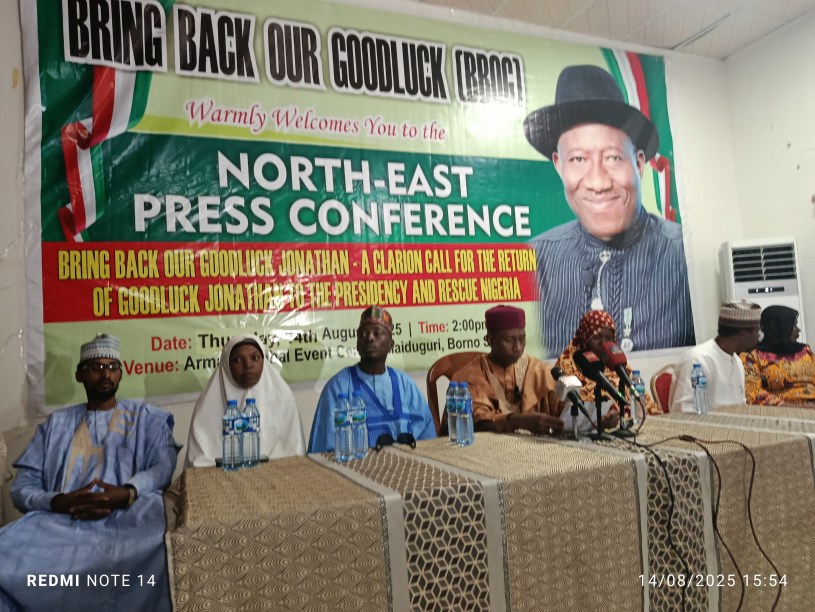
A decade after his government was defeated at the polls and his legacy was tainted by accusations of complicity with the Boko Haram insurgency, a political group from northeast Nigeria has issued a public apology to former President Goodluck Ebele Jonathan. The stunning reversal took place at a press conference on Thursday in Maiduguri, the capital of Borno State, a region at the epicentre of the extremist violence.
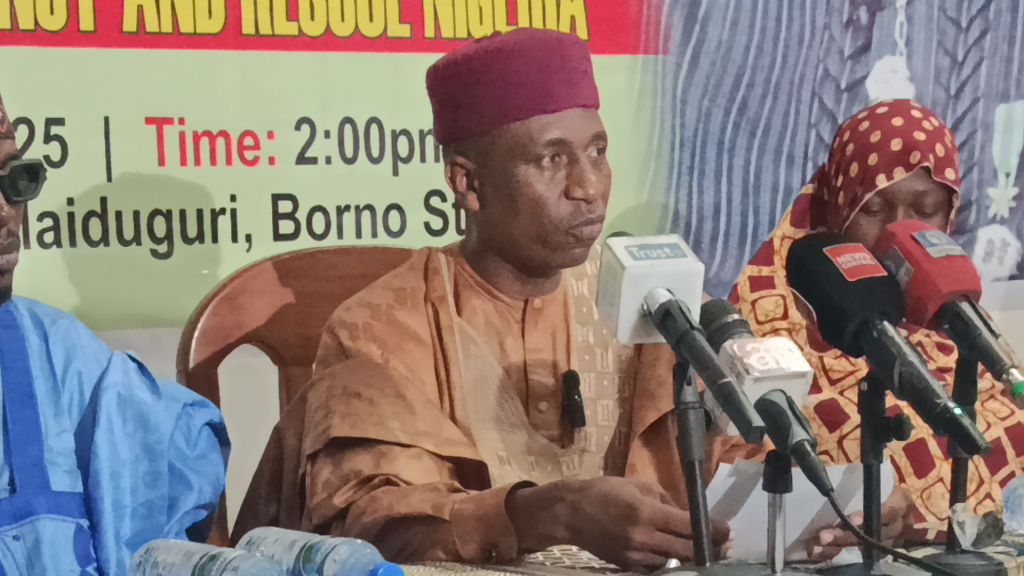
The group, “Bring Back Our Goodluck,” led by its National Chairman, Dr. Grema Kyari, confessed that their earlier opposition to Mr. Jonathan was based on misinformation. Dr. Kyari, a Borno native who was a prominent critic of the former president, acknowledged that he and countless others had been “misled.”
“During the presidency of Dr. Goodluck Ebele Jonathan, a damaging narrative was widely spread in our communities—that he sponsored Boko Haram and used the military to suppress us,” Dr. Kyari said. “These lies thrived in an environment of limited and restricted access to truth. But today, with broader exposure and clearer understanding, I know those accusations were false.”
The apology marks a profound shift in Nigerian political discourse, coming at a time when the country is grappling with its own set of economic and security crises. Dr. Kyari’s public mea culpa was framed not just as a personal or group apology but as a call to action.
The group now champions Mr. Jonathan as a “leader of integrity, compassion, and national vision” and is urging him to run for president again.
The press conference also presented a revisionist history of Mr. Jonathan’s 2015 ouster. According to the group, his defeat was not the will of the people but rather the result of “regime change orchestrated by foreign powers, especially the democats-Obama/Biden U.S. administration of 2014 in connivance with some desperate politicians in Nigeria.”
In their appeal for Mr. Jonathan’s return, the group highlighted several of his past actions as evidence of his fitness to lead today. They praised his decision to concede defeat in 2015, which they said prevented post-election violence and projected Nigeria as a “beacon of democratic maturity.”
The group also credited Mr. Jonathan with standing firm against international pressure, particularly from the U.S. under President Barack Obama, to legalize same-sex relationships. They pointed to his signing of the Same-Sex Marriage (Prohibition) Act in 2014 as a defense of Nigeria’s “cultural and moral values.” This was juxtaposed with a recent international agreement signed by the current administration, which the group suggested undermines those values.
Furthermore, Dr. Kyari contrasted Mr. Jonathan’s response to the 2012 “Occupy Nigeria” protests with the current government’s policies. He noted that Mr. Jonathan “listened” to public outcry and partially reversed a fuel subsidy removal, a move he described as a mark of humility. This, he argued, stands in stark contrast to the current government’s “abrupt” subsidy removal, which has led to widespread hardship.
The press conference concluded with an emotional plea for Mr. Jonathan to heed the call of the Nigerian people, citing his famous quote, “My political ambition is not worth the blood of any Nigerians,” as proof of his statesmanlike character. In a region where political allegiances have historically been deeply entrenched, the public apology and call for his return underscore the shifting political landscape in Nigeria.
 The Humanitarian Times