By Abdulkareem Haruna
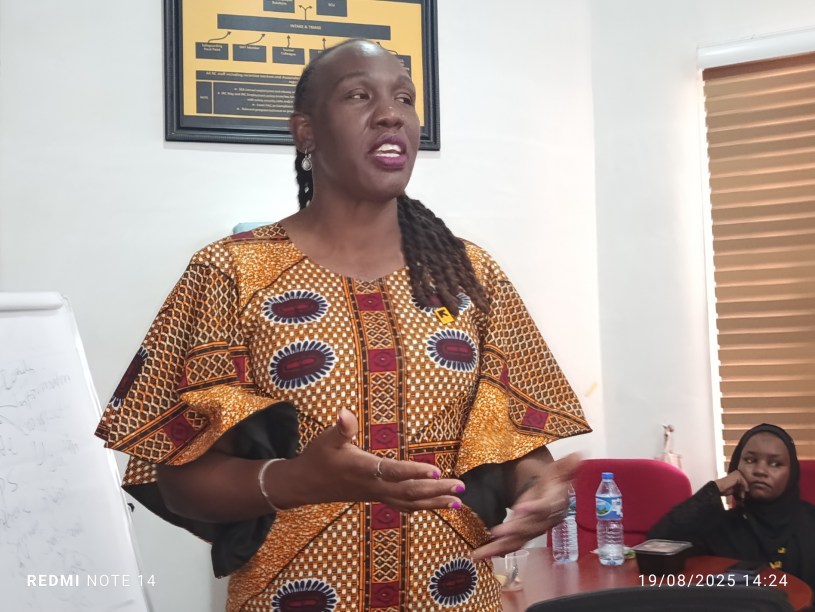
IRC Acting Country Director and Director of Programmes, Esther Agoriat. Photo credit: Abdulkareem Haruna/HumAngle
The International Rescue Committee (IRC) is facing a daunting challenge in its mission to provide humanitarian aid in Nigeria’s conflict-affected Borno State, northeast Nigeria. The organization is having to dramatically adapt its operations following significant funding cuts from the U.S. government, a primary financial backer of humanitarian efforts in the region.
During a recent media engagement and field tour of IRC projects in the state, Acting Country Director Esther Agoriat spoke to journalists about the organization’s new strategy. Her remarks shed light on the difficult decisions being made to sustain life-saving services despite a shrinking budget.
“We can’t claim to know everything,” Agoriat said, highlighting the constant need for adaptability. “We had to reduce our office space, shrinking it to nearly half its original size. This affected all three of our units because we were impacted by the funding cuts to the IRC.”
A New Approach to Resource Allocation
The funding shortfall has forced the IRC to rethink how it allocates its limited resources. Agoriat explained that the organization is shifting toward a more equitable distribution model to ensure a wider reach.
“It has become a case of ‘some for more’ rather than ‘more for some’,” noted Agora who also doubles as IRC’s Director of Programmes. She went on to explain, “When we have $100 for one location, we are now trying to use $50 in that location and split the remaining funds into two so that we can respond to all situations.” This new strategy, she said, aims to ensure that even with less funding, the IRC can still address critical needs across multiple communities.
Diversifying the Donor Base
To fill the financial void, the IRC said it is now intensifying its resource mobilization efforts. The organization is actively seeking new partnerships and diversifying its donor base, moving away from its previous reliance on the U.S. government.
“Now, all the efforts we are making are focused on bringing in more donors, even local ones,” Agoriat stated. The organization is exploring new avenues for support, including local philanthropies and corporate social responsibility programs.
Agoriat made a direct appeal to the journalists present, urging them to become “ambassadors” for the IRC’s mission. “If you know any philanthropists around,” she said, “you can use your influence… and tell them we are doing a good job.” She emphasized that working with the IRC would allow donors to see their contributions make a tangible difference on the ground.
The IRC has recently claimed that prior to the funding cut, the organisation has expended about $50 million
.
Navigating a Crisis: How IRC in Borno Adapts to Funding Cuts
 The Humanitarian Times