For years, the road to Maiduguri, the capital of Borno State was defined by the scars of an insurgency that sought to erase the very concept of the modern state. But in recent months and years, the narrative of Borno has shifted from one of survival to one of national magnetism.
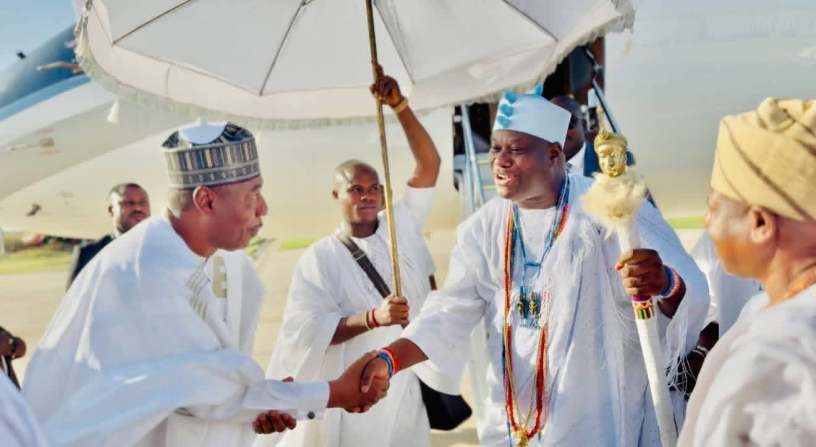
Last weekend, His Imperial Majesty, Oba Adeyeye Enitan Ogunwusi, the Ooni of Ife, stood in the heart of a city once besieged and issued a verdict that resonated far beyond the Northeast.
“A lot of us are watching you,” the Ooni told Governor Babagana Umara Zulum during a private audience. “You have proven to everybody that you are truly a reformer.”
The visit of the Ooni – the traditional supreme leader of the Yoruba people and Chairman of the Southern Nigeria Traditional Rulers Council – marks a significant moment in the political optics of post-insurgency Nigeria. It proved that Governor Zulum’s “Borno Model” of governance has transcended regional politics, catching the attention of the country’s oldest and most influential traditional institutions.
Since taking office as governor of Borno in 2019, Zulum, a professor of engineering, has approached governance with the precision of a builder. His administration has delivered over 1,200 projects, ranging from ‘mega schools’ to fortified resettlement villages.
The scale of this ambition was on full display in his 2025 “Budget of Recovery and Continuity,” a ₦584.76 billion plan that allocates 15% of its total – roughly ₦90 billion – to healthcare alone.
For the Ooni, who traveled nearly 1,300 kilometres from the ancient rainforests of Ife to the arid plains of the North, the physical transformation was undeniable.
“I always say to myself, ‘What is in Maiduguri that you are so passionate about?’” the Ooni remarked. “But today I came, and I now see why you are always running back. Borno is a beautiful state.”
Beyond the breathtaking brick-and-mortar successes, the meeting of the revered Yoruba monarch with Borno’s celebrity governor delved into a deeper, more evocative narrative: the historical kinship between the Kanuri of the North and the Yoruba of the Southwest.
The Ooni, a self-described student of history, invoked ancient ties to bridge the 1,300-kilometer geographic divide. He referred to the Kanuri as “cousins” and “blood relatives,” citing oral traditions that suggest a shared ancestry dating back centuries.
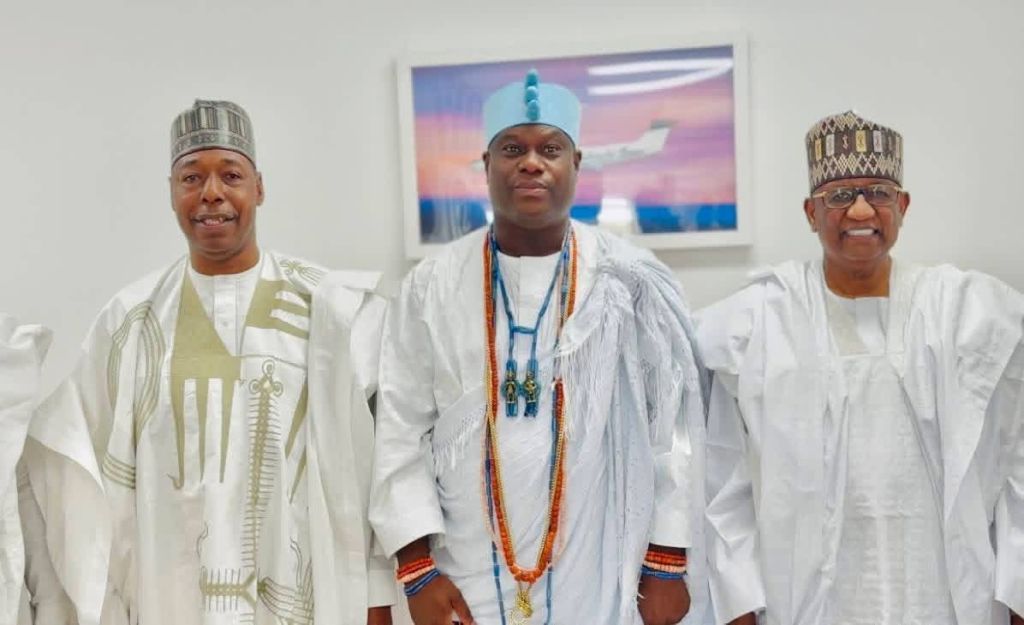
To solidify this fraternal bond, the Ooni presented Zulum with a symbolic Yoruba artifact—a gesture meant to remind the Governor that his work in the Northeast is a point of pride for the Southwest.
The monarch’s visit wasn’t merely ceremonial. Looking out over the vast Borno landscape—the largest landmass in the region at over 70,000 square kilometers—the Ooni pivoted to the state’s economic potential.
With the 2025 budget aiming to cultivate 150,000 hectares of land for rain-fed and irrigation farming, the Ooni declared himself an “advocate” for investment in the region.
The Goal: Utilizing Borno’s vast arable land to address national food security.
The Vision: Turning a former conflict zone into the “breadbasket of the country.”
We must not lose sight of the fact that the primary reason for Ooni’s history royal pilgrimage to Borno was the combined convocation of Kashim Ibrahim University, where the Ooni accepted an appointment as Chancellor. And it was acknowledged that in renaming the institution (formerly Borno State University) after the legendary statesman Sir Kashim Ibrahim, Zulum is leaning into a legacy of intellectual and traditional authority.
Governor Zulum, known for his stoic demeanor, expressed profound gratitude, describing the Ooni as a “unifying figure” at a time when Nigeria’s ethnic fault lines are often under strain.
Just like many other notable national and global figures the Ooni has come, saw and attested the Zulum signature – selfless and purposeful leadership unrivalled by many and equalled by only a few.
As the Ooni’s convoy departed, accompanied by a retinue of notable Yoruba monarchs including the Ajero of Ijero-Ekiti and the Alagba of Aagba, the message was clear: In the eyes of the nation’s traditional custodians, the Zulum style of leadership in Borno has transcend local success story—it is now a national benchmark.
 The Humanitarian Times